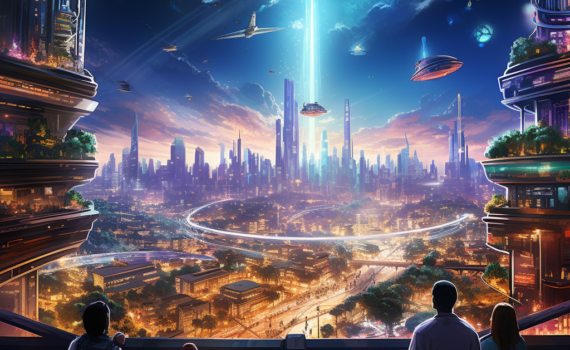
Greetings, dear readers and fellow space-time travelers, It is I, Percival Q. Higginbottom, your trusty guide to the unknown, the unexplored, and the highly fascinating. Today, we find ourselves journeying through the winding corridors of human imagination, all the way to the stars, as we delve into the captivating world of science fiction. Ah, science fiction! A genre that dares to dream, to ask “What if?” and to explore the furthest reaches of the cosmos without ever leaving our armchairs. From the mind-bending concepts of time travel to the ethical dilemmas of artificial intelligence, science fiction invites us to ponder the very fabric of reality. A Brief History of the Genre Our journey begins in the 19th century, where pioneers like Jules Verne and H.G. Wells laid the groundwork for the genre. Verne’s “20,000 Leagues Under the Sea” transported readers to the ocean depths, while Wells’ “The War of the […]
Space Exploration
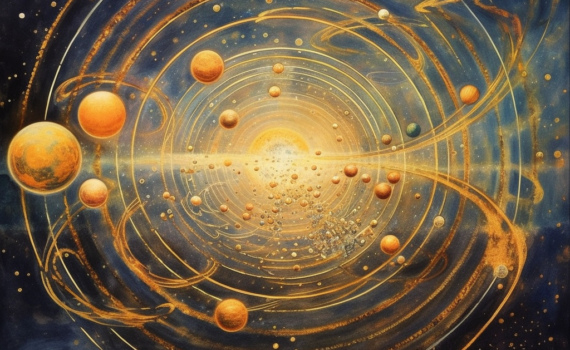
Greetings, dear friends, In the vast celestial waltz of the cosmos, planets move in intricate patterns, their paths dictated by the gravitational forces at play. There is one phenomenon, however, that stands out for its mesmerizing harmony: Orbital Resonance. Orbital resonance, dear reader, is a gravitationally mediated synchrony that planets or moons may share. These celestial bodies ‘dance’ in a rhythmic pattern, with their orbital periods bearing a simple, integer ratio to each other. This dance is not a product of chance or randomness but a mesmerizing demonstration of celestial harmony. Consider, for instance, the Jovian moons, Ganymede, Europa, and Io. These moons are in a 1:2:4 resonance, meaning that for every orbit Ganymede makes, Europa makes two, and Io, four. Such rhythm is nothing short of a cosmic ballet, a testament to the spectacularly precise nature of our universe. But why does orbital resonance occur, you may ask? The […]