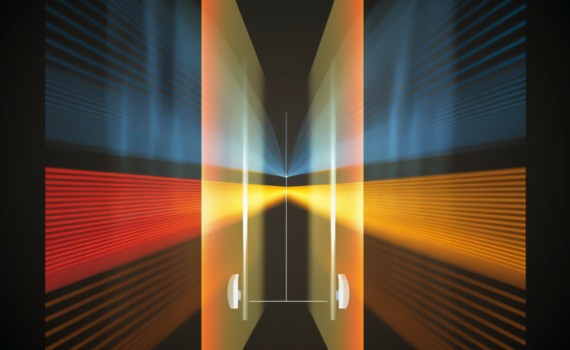
Greetings, dear readers! In today’s blog, we’ll dive headfirst into one of the most thrilling, perplexing, and enlightening domains of science: quantum physics. Specifically, we’ll explore the revolutionary Double-Slit Experiment—an experiment that I assure you, despite its seemingly simple setup, has upended our understanding of the physical world. But first, a gentle warning. Quantum physics, as Werner Heisenberg, one of the founding fathers of this theory, once said, “is a realm where our everyday logic collapses”. So, buckle up for a fascinating, albeit strange, journey. Our tale begins in the 19th century, when light was largely understood as a wave phenomenon. Then, a man named Thomas Young, in a simple but ingenious experiment involving light, two slits on a barrier, and a screen, presented us with an interesting quandary. Young shone light—imagine it as a wave of crests and troughs—on a barrier with two slits. Logically, one might expect to […]
quantum physics

Time – an abstraction as ubiquitous as it is elusive. We measure it, spend it, waste it, and constantly run out of it. We perceive it as linear, forward-moving, a ceaseless march toward the future. But is time merely a human construct, a framework we’ve imposed on the cosmos to make sense of our existence? Or does it have an objective reality independent of human consciousness? In the realm of philosophy, time has been a topic of profound speculation for millennia. Ancient Greek philosophers such as Heraclitus and Parmenides debated the nature of time, with Heraclitus positing that everything is in flux and time is an ongoing process of change. In contrast, Parmenides argued that time is illusory, and reality is timeless and unchanging. Fast forward to the modern era, where philosophers like Immanuel Kant contended that time is not an objective entity but a fundamental part of our mental […]

Ah, greetings, dear readers! ‘Tis I, your favourite aficionado of all things intriguing, Percival Q. Higginbottom. Today, we’re venturing into the remarkable world of quantum computing. Hold onto your top hats, because we’re about to dive into a universe where the usual rules of reality take a holiday. Picture this: a computer that can perform millions of calculations at once, solve complex problems faster than a speeding bullet, and potentially unlock new frontiers in everything from drug discovery to climate modeling. No, this isn’t a dream, or a page out of a science fiction novel. It’s the promise of quantum computing, the shining beacon on technology’s horizon. In the world of classical computing, we’re bound by the binary — the universe of 0s and 1s, off and on, black and white. But in the quantum realm, things aren’t quite so clear cut. Quantum bits, or qubits, can exist in multiple […]

Ah, Quantum Mechanics! The mere mention of it sends shivers down the spines of many, and for others, it’s an invitation to a whimsical waltz through the world of the incredibly small, where the usual rules of reality have taken a leave of absence, and in their place, we find a landscape of delightful paradoxes and thrilling impossibilities. In this fantastical land, particles can be in two places at once (a phenomenon known as superposition), and they can also be linked across vast distances, instantaneously affecting each other’s states (a phenomenon known as quantum entanglement). And let’s not forget our friend Schrödinger’s cat, that unfortunate feline who is both alive and dead until someone takes a peek inside the box. Now, I know what you’re thinking. “Percival, this sounds like a madhouse, a realm of chaos and disorder.” But, oh, how far from the truth that is! There is a […]