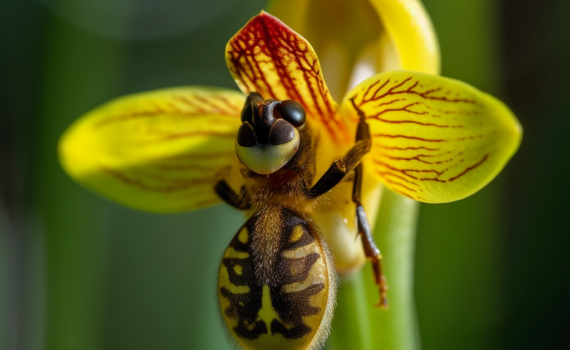
Orchids. They are a dazzling testament to nature’s creativity, found in every color, shape, and size imaginable. Some are extravagantly beautiful, while others are curiously strange. But beyond their visual allure, some of these flowers have evolved an extraordinary survival technique that seems almost deceitful. Today, dear readers, we delve into the realm of orchid mimicry. It is a tale that begins with the simple act of pollination. Flowers, to ensure their survival, need to transfer their pollen to other plants. Most achieve this feat with the assistance of unsuspecting pollinators – bees, butterflies, birds, and even bats. They entice these creatures with a promise of nectar, who then, in their quest, inadvertently pick up pollen and carry it to the next flower. However, some orchids have decided to take a different path. Rather than offering a reward, they have evolved to exploit the sensory biases of their pollinators. Orchids […]
plant science

Greetings, dear readers! Today, I invite you to accompany me on a wondrous journey deep into the heart of the forest, as we uncover the secrets of nature’s most stoic and steadfast denizens: trees. Far from being mere silent witnesses to the passage of time, trees are, in fact, active participants in the intricate dance of life that unfolds within their leafy embrace. Recent scientific discoveries have shed light on the remarkable ways in which trees communicate with one another, forming vast, interconnected networks that are essential to the health and survival of the forest ecosystem. At the heart of this system is the mycorrhizal network, a subterranean web of fungi that connects the roots of trees and other plants, facilitating the exchange of nutrients and information. Through this network, trees share essential nutrients such as nitrogen, phosphorus, and carbon, ensuring that all members of the forest community have access […]