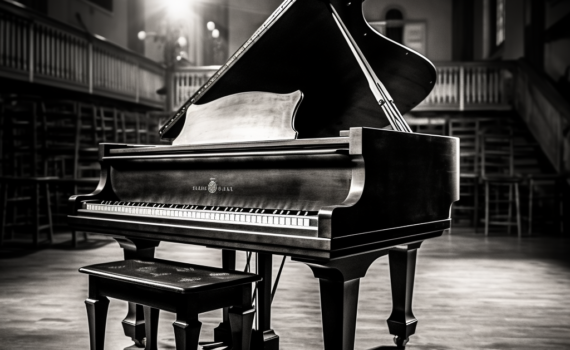
Dear readers, today, I invite you to join me on an intriguing journey, exploring an element of music that often goes unnoticed, yet remains central to the experience: silence. When we think of music, it is the notes, the melody, the rhythm that usually take center stage. But what about the silent interludes, the pauses, the breaks? Are they merely empty spaces, or do they hold a deeper significance? In music, silence is far from being an absence. It’s a powerful presence, an active participant that shapes the narrative of the composition. Pauses, in their seemingly contradictory role, serve to bring the notes, melodies, and harmonies to life. They provide room for the sound to breathe, the listener to reflect, and the music to resonate. The power of a well-placed pause is universal, reaching across various genres and styles. In classical music, composers like Ludwig van Beethoven were masters at […]
classical music

Howdy, art and music enthusiasts! Many a time, in my meanderings through life, I have wondered: can a vibrant painting sing? Can a symphony paint a picture? Today, we venture into the fascinating realm of synesthesia and the entwining relationship between art and music. In this journey, we look back to the ancient Greeks who, in their characteristic wisdom, saw music and the visual arts as inseparable sisters among the Muses. Fast-forward to the modern age, and we see this connection living on in Kandinsky’s ‘Color Studies,’ where he likened painting to orchestrating a symphony, with every color producing a unique sound in the viewer’s mind. Our exploration takes us further into the intriguing concept of synesthesia, a neurological condition where stimulation of one sensory pathway leads to automatic, involuntary experiences in a second sensory pathway. The great Russian composer Alexander Scriabin, a synesthete himself, created symphonies that were a […]
Greetings, dear readers! Today, we embark upon a delightful exploration of the intersection between the realm of music and the world of mathematics. Our esteemed guide for this expedition is none other than the baroque master Johann Sebastian Bach, whose ingenious compositions continue to captivate audiences centuries after his time. The beauty of Bach’s music lies not only in its harmonious melodies and intricate counterpoint, but also in its underlying mathematical structure. It is well known that Bach was fascinated by numbers and their relationships, and he often employed mathematical principles in his compositions. One particularly fascinating example of this is his use of the “golden ratio” in his music. The golden ratio, represented by the Greek letter phi (φ), is an irrational number that is approximately equal to 1.6180339887… It has long been associated with beauty and harmony in art, architecture, and nature due to its unique mathematical properties. […]