Oh, kindred spirits of cosmic curiosity, what if I were to whisper to you that beyond the starlit boundaries of our universe, there lies a kaleidoscope of worlds, each wrapped in the fabric of existence? Today, we shall embark upon a voyage, with our compasses set not merely on the stars but on the grander tapestry of reality itself. The theory of the multiverse proposes that our beloved universe, resplendent with its galaxies, stars, and planets, may be but a single piece in an inconceivably vast puzzle. Let us, gentle travelers, explore the Mystical Mosaic of the Multiverse. The notion of the multiverse takes root in the fertile soil of quantum mechanics and cosmology. When physicists began to unravel the fabric of reality at its tiniest scales, they found a realm teeming with uncertainty and probabilistic behavior. The esteemed Erwin Schrödinger, with his eponymous cat, introduced us to the notion […]
Astronomy
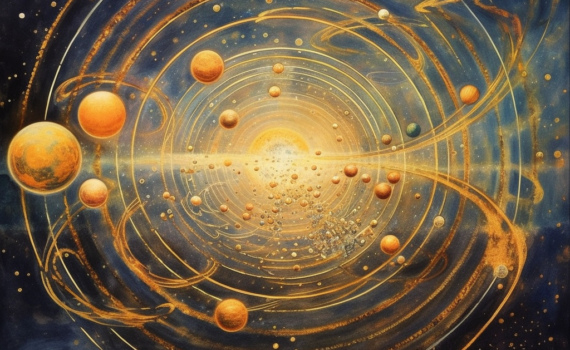
Greetings, dear friends, In the vast celestial waltz of the cosmos, planets move in intricate patterns, their paths dictated by the gravitational forces at play. There is one phenomenon, however, that stands out for its mesmerizing harmony: Orbital Resonance. Orbital resonance, dear reader, is a gravitationally mediated synchrony that planets or moons may share. These celestial bodies ‘dance’ in a rhythmic pattern, with their orbital periods bearing a simple, integer ratio to each other. This dance is not a product of chance or randomness but a mesmerizing demonstration of celestial harmony. Consider, for instance, the Jovian moons, Ganymede, Europa, and Io. These moons are in a 1:2:4 resonance, meaning that for every orbit Ganymede makes, Europa makes two, and Io, four. Such rhythm is nothing short of a cosmic ballet, a testament to the spectacularly precise nature of our universe. But why does orbital resonance occur, you may ask? The […]